
The Next Era of Customer Service: Human Expertise, Amplified by AI

Customer service has always been about people. Customers ask questions, explain problems, make requests, and expect someone to help them find the right solution.
For many businesses, that means customer service teams spend their days handling a constant stream of conversations. Some are simple and repetitive, while others require experience, empathy, and judgment.
As customer expectations continue to grow, businesses are looking for ways to respond faster and handle more conversations without losing the human element that makes good customer service valuable.
This is where AI comes in. The opportunity isn't to replace customer service teams with machines. It's to give them the technology to handle more, respond faster, and focus their attention where it matters most.
The future is not AI instead of humans.
It is human expertise, amplified by AI.
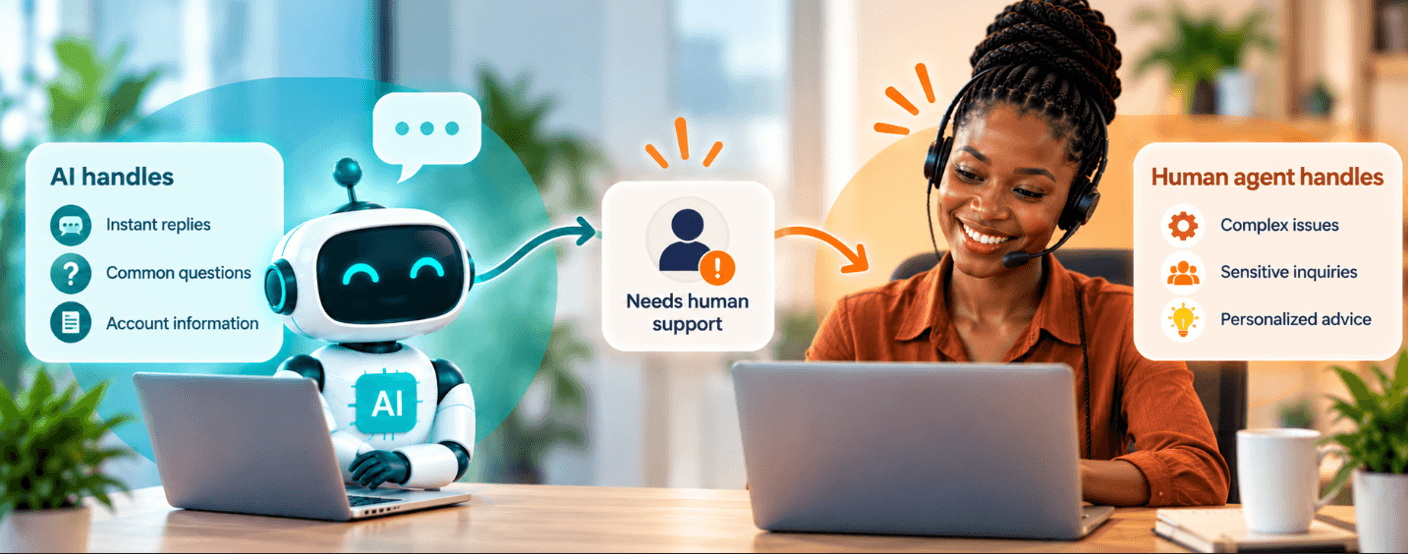
AI can handle the volume. Humans can handle the nuance.
Customer service teams spend a significant amount of time answering the same questions.
- What are your opening hours?
- How much does this cost?
- Do you deliver?
- How does this product work?
These questions may be straightforward, but hundreds of customers asking them at the same time can quickly overwhelm a support team.
AI can absorb much of this volume by providing immediate answers to common questions and helping customers find the information they need.
But not every conversation is straightforward.
Customers also have complaints, complex support issues, special requests, and situations where the right response depends on context.
These are the conversations where human judgment matters.
The goal, therefore, isn't to automate everything. It's to create a balance where AI handles the predictable while customer service teams focus on the personal and complex.
The quality of AI depends on the knowledge behind it
Effective AI customer service isn't simply about switching on an AI agent and letting it figure everything out.
AI needs context. Businesses have their own products, services, policies, processes, and ways of communicating. An AI agent needs access to this information to provide useful and relevant answers.
With platforms such as Axis Engage, businesses can provide their AI agent with FAQs, product documentation, and other business information.
This gives the AI a foundation based on the knowledge the business actually provides.
Instead of behaving like a generic chatbot, the AI can respond using information that is relevant to the business and its customers.
Not every conversation should be automated
Good customer service also means knowing when AI should step aside.
A customer might have a complaint, request a refund, raise a complex support issue, or simply need to speak to someone who can understand the situation and make a decision.
Businesses can define specific topics or keywords that require human intervention, allowing those conversations to be handed over to a human agent.
This creates an important principle for AI-powered customer service:
Automation needs boundaries.
AI should know what it can handle, while businesses decide when a human should take over.
AI makes customer service more scalable
Consider what happens when a business launches a major promotion.
The campaign performs better than expected, and suddenly hundreds of customers are asking questions through messaging channels.
Without additional support, response times increase, customers wait longer, and agents become overwhelmed.
AI provides another layer of support.
It can handle common questions, provide information, and manage the initial wave of conversations while human agents focus on interactions that require more attention.
This allows businesses to handle periods of high demand without needing every conversation to begin with a human agent.
AI doesn't just make customer service faster. It makes it more scalable.
The human touch becomes more valuable
There is an important shift happening as AI takes on more routine interactions.
The conversations that require human expertise become more valuable.
Empathy. Judgment. Problem-solving. Negotiation. Relationship building.
These are the moments where customers benefit most from human involvement.
AI doesn't make these skills less important. It gives customer service teams more opportunities to use them.
Instead of spending hours answering the same routine questions, agents can focus on the problems that don't have straightforward answers.
The opportunity isn't simply automation
It's easy to measure AI by how many customer service tasks a business can automate.
But that's only part of the opportunity. The bigger question is:
What can your customer service team do better because AI is helping them?
- Faster responses matter.
- Reduced workloads matter.
- 24/7 assistance matters.
But the real value comes when these improvements create a better experience for customers and give service teams more time to focus on the interactions that need human expertise.
That's the shift businesses should be thinking about.
Not simply automating customer service, but augmenting it.
What the next era of customer service looks like
The future of customer service doesn't have to be AI versus humans.
It can be a partnership.
- AI handles repetitive questions.
- AI uses the knowledge the business provides.
- AI helps manage spikes in demand.
- AI identifies conversations that need attention.
And humans step in when experience, empathy, and judgment matter most.
Platforms such as Axis Engage are helping businesses move toward this model by combining AI-powered conversations with the ability for human agents to take control when needed.
The goal isn't to make customer service less human. It's to give customer service teams better tools to be human where it matters most.
The businesses that get AI right won't necessarily be the ones that automate the most.
They'll be the ones that understand what to automate, what to protect, and where human connection matters most.
Because the next era of customer service isn't human versus AI.
It's human expertise, amplified by AI.