
How to Use AI Without Making Your Customer Service Feel Robotic
AI is changing the way businesses handle customer service.
It can answer questions instantly, handle repetitive requests, and help teams manage hundreds of customer conversations at the same time. But there is a concern that comes with this shift: how do you use AI without making customer service feel robotic?
The answer isn't to avoid automation. It's to make sure your AI understands your business, knows what it can and cannot handle, and knows when a human should step in.
With the right information and boundaries, AI can make customer service more efficient without taking away the human element.
Give AI the information it needs
An AI agent is only as useful as the information it has access to.
Customers expect answers that are relevant to the business they are speaking to. Generic responses aren't enough when someone is asking about a specific product, pricing, delivery policy, or service.
With Axis Engage, businesses can provide resources such as FAQs, product documents, policies, and other business information to guide the AI agent. This gives the AI a knowledge base built around the business.
Instead of relying on generic answers, the AI can use the information the business provides to respond to common customer questions more accurately and consistently.
This matters because trust is a major part of customer service.
Research on hybrid AI operations found that business-grounded AI significantly reduced false responses and was associated with higher post-chat customer satisfaction. The lesson is simple: the better the context you give AI, the more useful its responses can become.
Decide when a human should take over
Good customer service isn't about automating every conversation. Some situations require human judgment. A customer may have a complaint, request a refund, want to cancel an order, or have a complex issue that requires someone to understand the situation before deciding what to do.
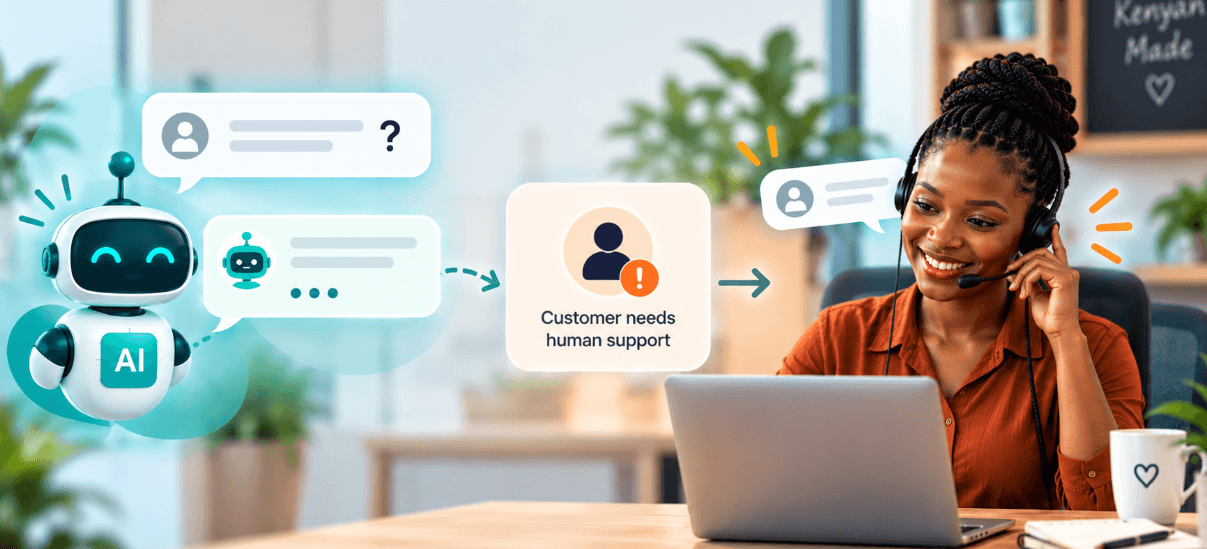
Axis Engage allows businesses to define topics and keywords that should trigger human intervention.
For example, conversations involving:
- Complaints
- Refunds
- Cancellations
- Complex support issues
can be directed to a human agent.
This creates a clear boundary between what AI handles and what your team handles. The AI can manage routine interactions while your team steps in when a conversation needs empathy, judgment, or personal attention.
Let AI handle the repetitive questions
Customer service teams often spend a significant amount of time answering the same questions.
- What's the price?
- Do you deliver?
- What are your opening hours?
- How do I place an order?
These questions may be simple, but they can take up a significant amount of a team's time when customers ask them repeatedly.
AI can handle these routine interactions instantly, giving customers the information they need without making them wait for an agent.
At the same time, customer service teams have more time to focus on conversations that actually require their expertise. The goal isn't to remove people from customer service. It's to stop making people spend their time on questions that don't require them.
AI should know when it isn't enough
One of the biggest differences between good and bad AI customer service is knowing when to stop. An AI agent shouldn't try to answer every question at all costs.
Sometimes the best response is to recognize that a human is needed and make that transition smoothly.
This is where automation and human support work together.
- AI handles the predictable.
- Humans handle the nuanced.
And customers get a faster response without losing access to the people who can help when things become more complicated.
The goal isn't to make customer service less human
The best use of AI isn't to make every customer interaction automated. It's to make the overall customer experience better. Give AI the right information, and it can provide more relevant answers.
Give it clear boundaries, and it knows what it should handle. Give customers a path to a human, and your team can step in when the conversation needs more than automation.
That's what makes AI-powered customer service feel less robotic.
The goal isn't AI that replaces the human touch. It's AI that knows when the human touch matters.